
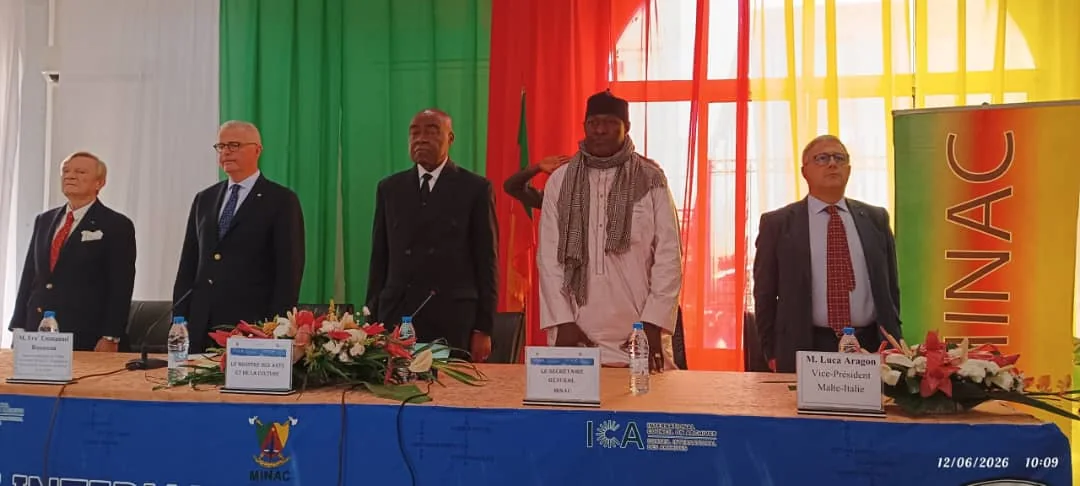
The activities marking the commemoration of the 8th edition of International Archives Week in Cameroon came to an end today in the convivial hall during an official ceremony bringing together a gathering of high-ranking dignitaries.
This closing ceremony was solemnly chaired by the Minister of Arts and Culture, accompanied for the occasion by Mr Fra’Emmanuel ROUSSEAU: Grand Commander of the Order of Malta, H.E. Jean Christophe HEIDSIECK: Ambassador of the Order of Malta to Cameroon, Mr Luca ARAGONE: Vice-President of the Order of Malta Italy and several other high-ranking dignitaries.
Held under the theme: “Sovereign archives for historical truth, social justice and digital governance in Cameroon”. Under the supervision of the Ministry of Arts and Culture, the National Archives of Cameroon led the organisation of this celebration, which comprised two main activities, namely a round table with professionals and a study day devoted to in-depth reflection on the theme.
The Director of the National Archives of Cameroon, in his opening remarks, stated that during this week now ending, professionals, students and national and international partners shared their thoughts on a question that has become central for our societies:
the mastery of information, evidence and memory in the digital age.
Three major developments emerge from these exchanges, namely:
The creation of professional associations in the field,
the harmonisation of good archiving practices and the profession itself.
In his address, Mr Fra’Emmanuel ROUSSEAU stressed that, as Pope Leo XIV indicated during his recent visit to Cameroon, we must advocate justice and peace. Archives are important vehicles for the promotion of justice and peace in Cameroon. He then welcomed the Cameroonian Government’s initiative in renovating the building that houses the National Archives of Cameroon, which proves that archives are of capital importance. The guest of the day also extended his sincere congratulations to the Director of the ANC for his valiant dynamism and commitment.
In his speech, the Minister of Arts and Culture affirmed that the proceedings of this week have shown that archives occupy a growing place in the concerns of public and private actors. The interest shown in electronic archiving, records governance, the protection of personal data, professionalisation and information sovereignty bears witness to this. MINAC welcomes this momentum, which confirms that archives are now perceived not only as a heritage to be preserved, but also as a strategic resource for the modernisation of public action and national development.