
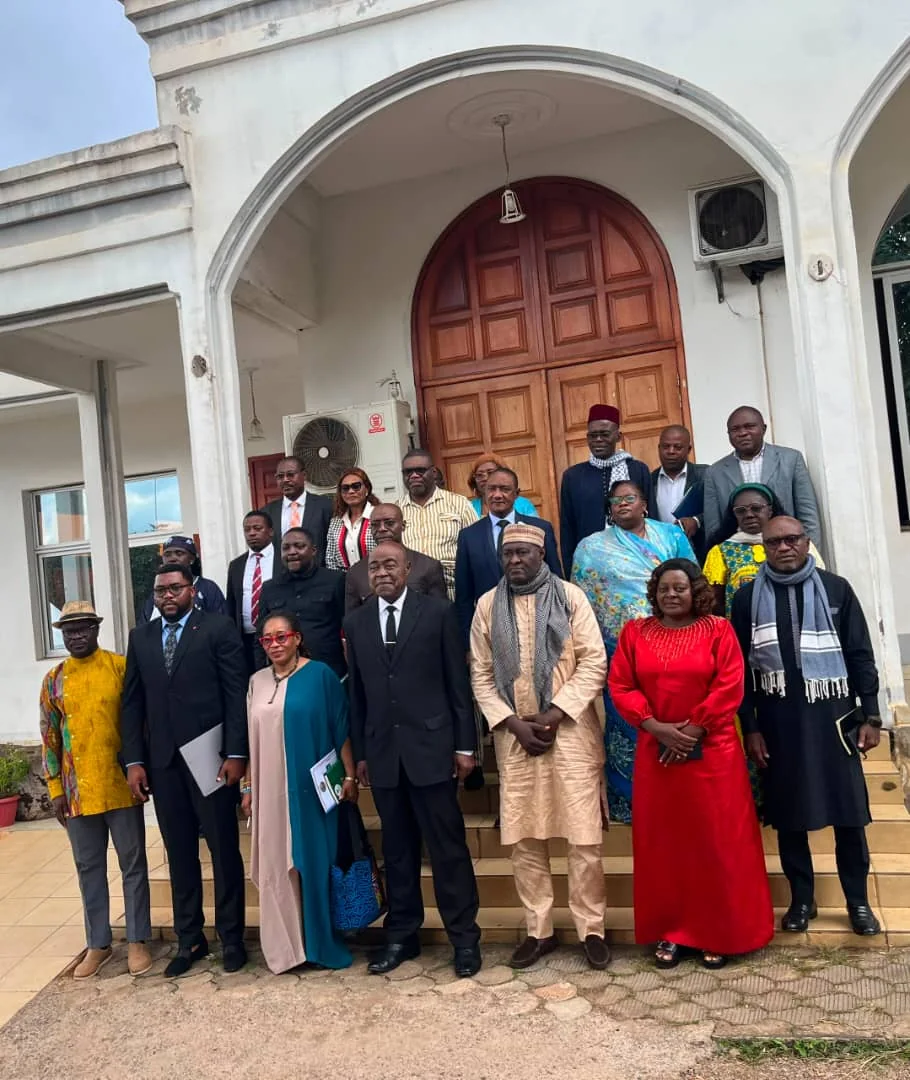
The Minister of Arts and Culture granted, on Friday 14 August 2026 at 1 pm, in the Convivial Hall, an audience to Mr Paul Eddy Tsoungui, Chief Executive Officer of the International Indigenous Peolples Organization (IIPO), a non-profit international organisation working for the protection of the rights, cultures, languages and heritage of indigenous peoples around the world. Accompanied by his delegation, he presented to the Minister the prospects for cooperation in favour of the promotion, safeguarding and enhancement of the cultural heritage of the indigenous peoples of Cameroon.
At the start of the discussions, the customary courtesies were exchanged. The Minister of Arts and Culture welcomed Mr Paul Eddy Tsoungui and his delegation, while reaffirming his department’s readiness to examine initiatives that contribute to the preservation and promotion of indigenous cultural heritage.
In his remarks, Mr Paul Eddy Tsoungui outlined the International Indigenous Peolples Organization (IIPO)’s three-year partnership programme for 2026-2029, focused on national and international cooperation.
The programme presented aims in particular at the preservation of tangible and intangible cultural heritage, the promotion of traditional artistic expressions, the documentation of languages and ancestral knowledge, and support for indigenous artists and artisans. It also provides for the creation of permanent spaces for intercultural dialogue and the strengthening of young people’s participation in the transmission of traditions and knowledge.
Mr Paul Eddy Tsoungui stressed IIPO’s wish to work closely with Cameroonian institutions, in an approach based on listening, respect for communities and the joint development of projects. He explained that the organisation wishes to help give an international dimension to Cameroonian cultural heritage, by fostering exchanges with the First Nations of Canada and other indigenous peoples around the world.
IIPO requested the institutional support of the Ministry of Arts and Culture for the organisation, in collaboration with the Cameroonian association SUBI BABA YI DILALAN, of a series of cultural activities devoted to the indigenous peoples of Cameroon and Canada. These activities are scheduled for Monday 24 August 2026 at the NGOYANG community hall in Lolodorf. They are expected to include traditional dance performances, activities to share culinary art and a presentation of gifts to the beneficiary communities.
The working session continued with an examination of the main areas of collaboration between IIPO and the Ministry of Arts and Culture. The discussions covered the identification of communities, artists, artisans and knowledge holders likely to take part in the project, as well as the possibilities for technical support and institutional communication.
The Ministry’s representatives noted that the project is in line with the priorities relating to the preservation, transmission and promotion of Cameroonian cultural heritage. They also insisted on the need to carry out the activities with respect for the customs and traditions, cultural rights and interests of the communities concerned, with their free and informed consent.
The discussions also highlighted the value of developing a Cameroon-Canada pilot programme, which could serve as a model for extending cooperation with other indigenous communities in Africa and around the world. Such an initiative could contribute to cultural diplomacy, closer ties between peoples, community solidarity and the mobilisation of institutional, technical and financial partners.
At the close of the discussions, the Minister of Arts and Culture took note of the approach presented by the IIPO and expressed his interest in the partnership prospects discussed. The relevant technical services were asked to examine the file, make appropriate proposals and follow up the exchanges with the organisation and its partners.
This audience thus opens new prospects for more structured, inclusive and sustainable Cameroon-Canada cultural cooperation, based on the safeguarding of indigenous heritage, the intergenerational transmission of knowledge, the circulation of artistic expressions and the delivery of joint cultural activities.