
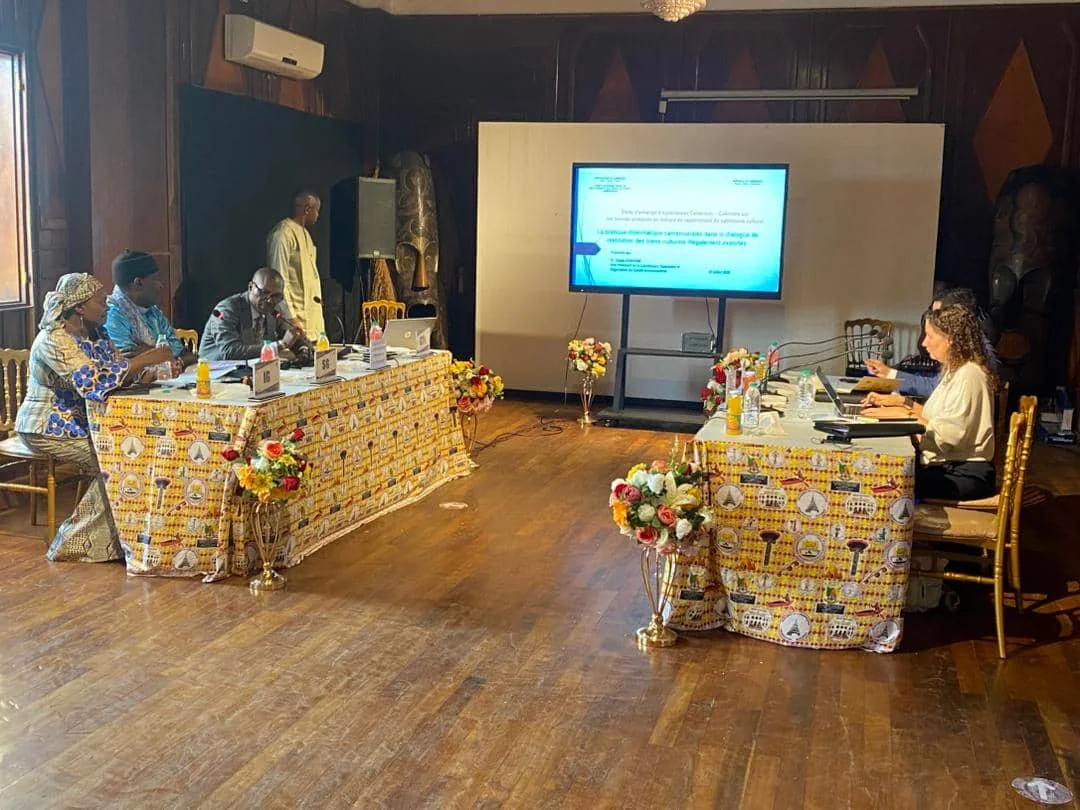
After the welcome ceremony, the first exchange session between the members of the committees in charge of the repatriation of illicitly exported cultural property from both sides was held in the Bimbia room. The chairs of the commissions of the Cameroonian side are to present papers relating to their themes.
Under the moderation of the Secretary General of the Ministry of Arts and Culture, the discussions of this first day covered four key themes.
Cultural diplomacy and South-South cooperation: Presentation by Professor KEMOGNE Basile, Chair of this commission and also Inspector General at the Ministry of External Relations. The chair presented a paper on the following
four concerns:
- The levers of pressure available to us to counter the legal arguments put forward by Western holders of our heritage;
- The measures for using North-South trade agreements as leverage to include clauses on the repatriation of heritage property.
- The existence or not of a legal framework bringing together Southern countries in their common claims against Western countries regarding the restitution of colonial
cultural property.
- And, if such a framework exists, the possibility for Colombia to be included, as a Southern country that protects its cultural property against illicit trafficking or the predation of unscrupulous dealers.
From seizure to proof: seizures and judicial procedures. Presentation by Professor SIETCHOUA Célestin, Director of Legal Affairs at MINAC, who set out the law on procedures relating to the repatriation of cultural property illegally exploited abroad. It involved an analysis of the repatriation regime for cultural property, following an analysis of the 2013 law, supplemented by its 2020 implementing decree, the 2022 order on the interministerial committee and the 2024 decision setting up the commissions within that committee. He pointed out that repatriation law has two characteristics that define its identity. First, the interministerial committee as the essential body in charge of repatriation. Second, diplomatic negotiations to conduct repatriation operations.
Preventing illicit trafficking: surveillance, databases and international cooperation.* Developed by Mrs EDJOA Akoa, Director of Cultural Heritage at MINAC, who highlighted the fight against illicit trafficking in Cameroon, mentioning the implementation of UNESCO’s 1970 Convention, which deals with combating trafficking and determines which items are cultural property. In Cameroon’s case, the Ministry of Arts and Culture, which is responsible for matters of trafficking in cultural property, has taken measures by setting up an inventory in order to protect cultural property. This is a process carried out every year, and thus makes it possible to have a consistent database to identify Cameroonian cultural property. Following this inventory, still in the context of the fight against trafficking in cultural property, partnerships have been established with law enforcement and security forces, namely the gendarmerie, the police and customs, on the need to preserve cultural heritage in times of conflict. As regards the platform set up to bring together the Ministry of Arts and Culture and the law enforcement forces, campaigns against illicit trafficking are intensifying. These inventories make it possible to know the cultural objects, with the support of UNESCO at the international level by providing a database of lost objects.
Structuring proof; from provenance to negotiation: presentation by Mrs OLEMBE Esther, Director of the National Archives, who dwelt on a practical case. In a system centred on combating trafficking, restitution comes as the outcome of a judicial procedure. But when the objects are old, scattered and integrated into foreign collections, the logic changes profoundly. It is no longer only a matter of demonstrating an illegality, but of building legitimacy.
This means identifying the objects precisely, reconstructing their historical trajectory, characterising the conditions of their removal, and formulating a structured request that combines law, history and diplomacy. Restitution no longer rests only on facts: it rests on an architecture of proof.
The Cameroonian case illustrates the scale of the task. A considerable part of our heritage is abroad: more than forty thousand objects identified in German collections alone, as well as a significant number of human remains, a category that calls for specific protocols. Such a scale rules out case-by-case improvisation: it requires a methodical response, built before it is declared. This is also why the Cameroonian side has not yet formally replied to the German side: this relative silence is not hesitation, but the condition for a solid position.
Building legitimacy finally has an internal dimension, too often neglected. Restitution affects the four cultural areas of Cameroon; if conducted without care, it can become a source of tension between communities. Provenance research therefore also serves to establish, with the communities concerned, who the legitimate custodians are and where the objects should return to, even before the object comes back. This difficulty is not specific to Cameroon: Colombia itself, aware of what is at stake, has recently delayed its request concerning the Quimbaya treasure, while clarifying to whom the pieces should return.
The question of the legitimate recipient is therefore shared and central.
A legal singularity reinforces this caution. Under international law, Cameroon was never a colony in the strict sense. The German regime established from 1884 was, in form, a protectorate (Schutzgebiet) based on treaties concluded with local authorities, and not an administration of the colonial type. After the First World War, the territory came under a League of Nations mandate, then under United Nations trusteeship. From protectorate to mandate, then to trusteeship, Cameroon was run in the manner of a colony without ever having its status. This peculiarity, long left in the background, resurfaces with the question of restitution and complicates its handling: the power that took away most of the objects is not the one that subsequently administered the territory, and the applicable regime raises questions of status and State succession.
This is why the State of Cameroon holds to a clear principle: restitution is conceived State to State, and not as a direct negotiation between the holding countries and the communities, a route which those countries nevertheless tend to favour. Dealing directly with the communities would fragment the claim, bypass the State, risk reviving tensions between cultural areas, and make it possible to evade the underlying questions, starting with that of reparations. State-to-State restitution is not a protocol formality: it is a guarantee of sovereignty, national unity and coherence of the claim.
At the end of this first day rich in sharing experiences, the Colombian delegation expressed its deep gratitude for the quality of the information made available to it.